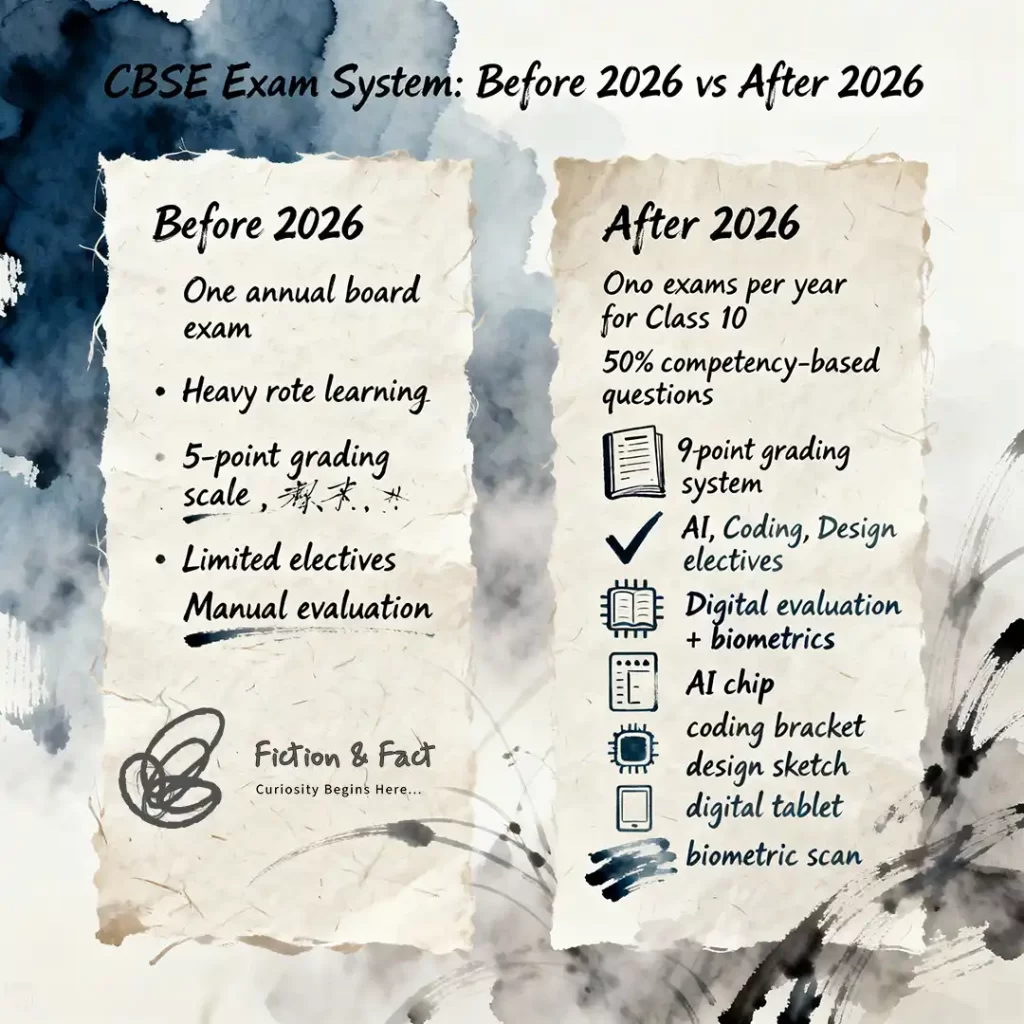
The Indian education system is seeing one of its biggest shake-ups in recent years. For decades, many students have experienced an exam culture dominated by rote memorization, last-minute cramming, and high stress before board exams. However, with the 2026 reforms announced by CBSE aligned with the National Education Policy 2020 (NEP 2020) that is set to change. The reforms promise a shift toward competency-based learning, multiple board attempts per year (for Class 10), new skill-based electives, a more nuanced grading system, digital evaluation and a stronger emphasis on conceptual understanding and real-life applications.

In this blog, we break down the key changes, what they mean for students, parents and schools and how to prepare for this new era of learning.

What’s Changing: Key Reforms at a Glance

Reform / ChangeWhat It Means
Competency-Based Assessment (≈50% of paper)Half of the questions across board exams will test conceptual understanding, analytical thinking, problem-solving, and application of knowledge less emphasis on memorization. (Press Information Bureau)
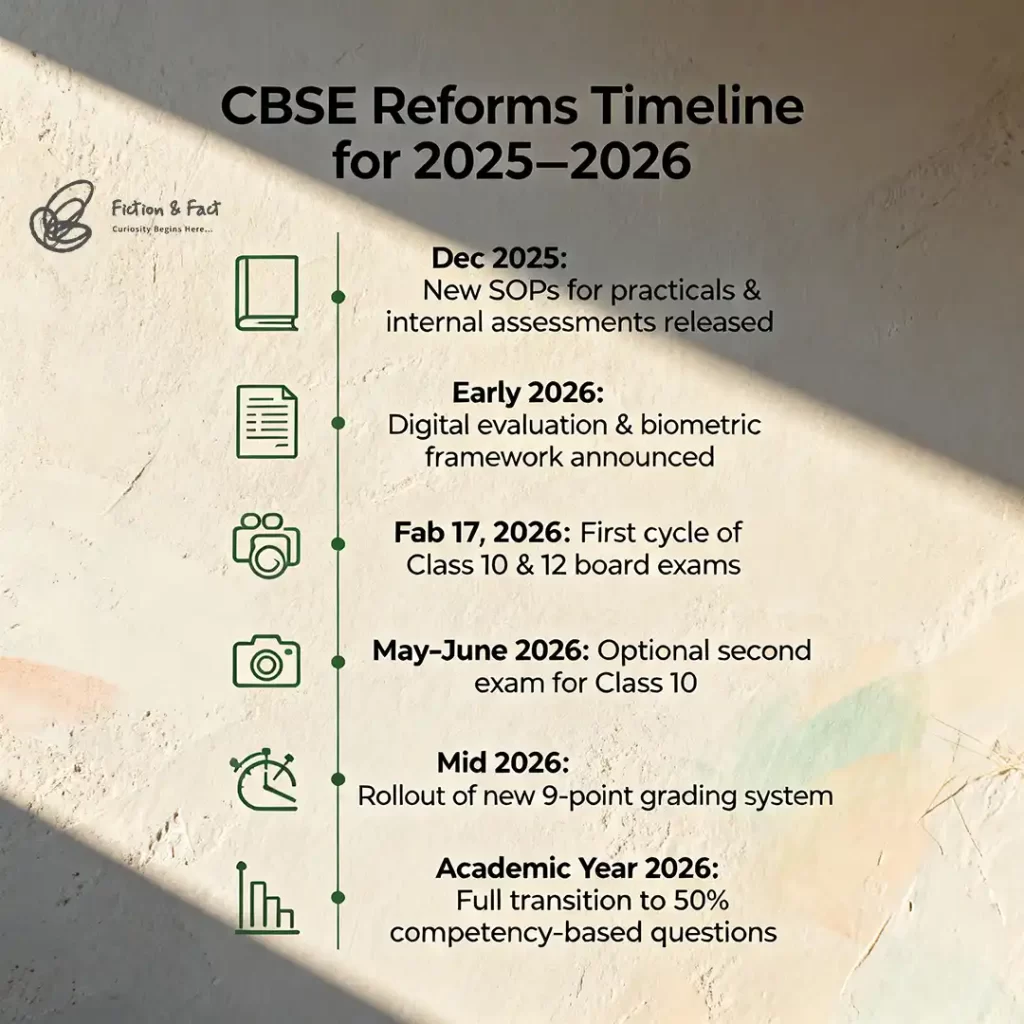
Two Board Exams per Year for Class 10From 2026, Class 10 students will get two chances annually: a mandatory main exam (around February) and an optional improvement exam (around May/June). The higher score will be retained. (CBSE)
9-Point Grading ScaleThe older 5-point grading will be replaced by a more granular 9-point scale. The top 12.5% will get the top grade (A1). This allows more nuanced differentiation among students. (www.ndtv.com)
Skill-Based Electives (e.g. AI, Design Thinking, Coding, Data Science, etc.)Students will have options beyond traditional academic subjects enabling them to build future-ready skills and explore emerging fields. (www.ndtv.com)
Digital Evaluation & Modern Assessment MethodsAnswer sheets may be evaluated on-screen (digitally), possibly with biometric verification, pushing schools toward modernization. This improves objectivity, reduces manual errors, and aligns with global trends. (The Economic Times)
Stricter Attendance & Internal Assessment Discipline75% minimum attendance requirement is now mandatory. Internal assessments, practicals/projects carry weight, and schools must follow updated SOPs for practical/internal exams. (The Economic Times)

CBSE 2026 Reforms

Key Changes You Must Know

A quick visual guide to the new competency-based, future-ready CBSE board exam structure.

Competency-Based Questions (50%)

From Rote to Real Understanding

Half of the paper will now test how well students can apply what they’ve learnt.

  • MCQs that test concepts, not just memory
  • Case-study based questions
  • Application and problem-solving tasks
Two Board Exams (Class 10)

More Flexibility, Less Fear

Class 10 students get two chances each year to sit for the board exam.

  • February exam – mandatory
  • May exam – optional improvement
  • Best score will be counted
New 9-Point Grading Scale

More Detailed, Fairer Grading

The earlier 5-point system is being replaced with a more detailed 9-point scale.

  • Better distinction between performance levels
  • Top 12.5% receive A1
  • Recognises nuanced improvement
Skill Subjects Introduced

Future-Ready Learning

New electives help students build real-world and career-relevant skills.

  • Artificial Intelligence (AI)
  • Coding & Programming
  • Data Science
  • Design Thinking
Digital Evaluation System

Smarter, More Secure Checking

Evaluation moves towards secure and tech-enabled processes.

  • On-screen checking
  • Biometric verification
  • Reduced manual errors
New Attendance Rule

Consistency Matters

Regular school attendance now plays a bigger role.

  • Minimum 75% attendance required
  • Internal assessment weightage increased
  • Daily participation encouraged

Why This Shift? The Bigger Picture & NEP 2020 Alignment

The reforms are part of the broader vision of NEP 2020 which emphasizes holistic, learner-centered, competency-based education over rote memorization. NEP advocates assessments that measure real understanding, real-life skills, and adaptability, not just retention.

Under the earlier system, board exams prioritized memory-based recall often promoting rote-learning and coaching culture. Critics argued this limited creativity, critical thinking, and real-world readiness. The shift aims to break that cycle and equip students better for the 21st-century world.

The two-exam-per-year model also reduces stress: students get a second chance if first attempt didn’t go well. This aligns with a more compassionate, growth-oriented education philosophy.

The addition of skill-based electives (AI, Design Thinking, etc.) acknowledges changing academic and career needs. These electives prepare students for future fields and encourage exploring talents beyond traditional streams.

Who Benefits

Deep Understanding over Rote Memory: Students will likely develop stronger conceptual clarity and problem-solving skills.

Reduced Exam Stress: With two exam windows, students get a second chance potentially reducing anxiety and pressure.

Flexibility & Future-Readiness: Skill-based electives give exposure to modern subjects (like AI, design, coding), making education more relevant for future careers.

Fairer Evaluation: 9-point grading + digital evaluation + competency-based questions mean better differentiation and potentially fairer assessments.

Holistic Learning: Internal assessments, projects, practicals, and real-world applications will encourage consistent engagement, not just last-minute cramming.

Challenges & What Needs to Be Done

Teacher Training & Preparedness: Shifting from rote-based teaching to competency-based requires teachers to redesign lesson plans, adopt new pedagogies, and assess differently. Schools need to invest in training.

Infrastructure and Digital Readiness: For digital evaluation, schools need proper digital infrastructure (computers, internet, scanning facilities). Without it, lag or inequities may arise. 

Change Management: Students, parents, and schools accustomed to old methods may find it challenging to adapt. Shifting mindset from memorization to understanding may require time.

Consistency Across Schools: Implementation must be uniform otherwise, disparities between “well-equipped” and “less-equipped” schools may widen.

Internal Assessment Integrity: With more weight on internal assessments and practicals, schools must maintain transparency and fairness in marking else, pressure may shift from boards to internal marks.

What This Means?

For Students

Focus on Concepts & Understanding not Just Memorizing: Adopt study habits that emphasise clarity, application, problem-solving, and real-life examples.

Practice Competency-Based Questions: Work more with MCQs, case studies, application-based problems rather than only descriptive answers.

Use the Second Exam Window if Needed: Don’t panic if the first attempt isn’t great, you’ll have another shot soon. Plan accordingly.

Explore Skill Electives Early: If your school offers electives like AI, Design Thinking, Coding; consider opting in. It might help align with future interests or career paths.

Stay Regular in School: With attendance thresholds and internal assessments being important, consistent class attendance and participation is now essential.

For Teachers & Schools

Update Pedagogy: Move away from lecture-heavy, rote-based teaching. Instead, design lessons promoting critical thinking, problem-solving, group activities, projects, real-world applications.

Train & Upskill: Teachers may need training in competency-based instruction, digital assessment tools, new evaluation formats.

Upgrade Infrastructure: For digital evaluation, schools must ensure scanning facilities, computers, internet connectivity, secure evaluation workflows.

Fair & Transparent Internal Assessment: Practical work, projects and assessments need to be conducted with integrity; clear guidelines must be followed.

Counsel Parents & Students: Since this is a big change, parents and students need awareness about what’s changing, what to expect and how to prepare.

For Parents

Support Conceptual & Critical Thinking: Encourage children to understand, question, discuss, rather than just memorize.

Value Skill-Based Electives & Broader Learning: Help kids explore interests in newer subjects (AI, design, etc.) that may benefit their future.

Encourage Regular Attendance & Participation: Since internal assessments now matter, consistent class attendance and engagement count.

Focus on Growth, Not Just Marks: With two exam windows and competency-based evaluation, the mindset can shift from “rote-to-get-high-score” to “understand-to-learn”.

Wider Implications

The 2026 reforms mark a structural transformation in how exams will be conducted moving India’s largest board toward global best practices: competency-based evaluation, digital assessment, skill-oriented electives.

Over time, this could lead to a reduction in coaching-culture and exam-oriented learning, instead encouraging holistic development, critical thinking and real-life readiness.

It may foster equity and modernization: if implemented properly, digital evaluation + competency-based assessment might reduce bias, favour schools with competent teaching staff and infrastructure, and reward true understanding rather than rote memorization.

The reforms also align with changing global demands: as industries evolve, skills like problem-solving, analysis, design thinking, data literacy rather than mere bookish knowledge will matter more.

Further Research & Resources

  • The NEP 2020 document: outlines broad vision and structural changes in Indian education.
  • CBSE’s official notification for “Two Board Examinations for Class X from 2026”. 
  • CBSE’s circular on assessment & evaluation practices (aligning with Competency-Based Education). 
  • Analysis articles on what competency-based assessment means for students: benefits, challenges, real-life application. 

Visited 54 times, 1 visit(s) today
Was this article helpful?
YesNo

Comments are closed.

Close Search Window